- Growth Shuttle Insider
- Posts
- Why mid-market companies struggle with organic growth today
Why mid-market companies struggle with organic growth today
(how DevriX targets that with RevOps + WordPress)

Mario Peshev
April 22, 2026

Operators and investors,
Most mid-market portfolio companies ($30M to $250M revenue) share one unfortunate trait: they cannot grow organically without throwing more money at the problem.
I see this across every vertical we work in. Restoration companies, healthcare platforms, SaaS businesses, B2B distributors. The pattern is the same:
Revenue grows when ad spend grows.
Pipeline expands when headcount expands.
Pull the budget back by 15%, and growth stalls overnight.
I recently worked with a PE-backed $85M professional services company that had spent $10M+ on paid media over 12 months with almost zero organic pipeline. Their website was a brochure from 2019. Their CRM had no lifecycle stages. Marketing, sales, and CS shared nothing: not data, not KPIs, not even a Slack channel.
When we mapped their customer journey, it had nine handoff points and exactly zero documented SLAs between teams.
This is what "organic growth failure" actually looks like.
I've been writing about this across multiple outlets for years now:
The 38 biggest business challenges growing companies face taught at dozens at universities since 2019
Integrating AI into business operations for Forbes
RevOps strategy for PE: unifying GTM & boosting EBITDA on my site again
Tech Pitfalls: Revealing Reputational And Legal Risks For Businesses for Forbes
And across hundreds of posts, advisory sessions with 400+ executives, and retainer work with companies doing $10M to $250M. Here's where the breakdown happens, and what we do about it.
1. The website treated as a liability vs. a revenue asset
This is where most conversations start, and where most PE-backed companies have the biggest blind spot.
The average mid-market portfolio company treats its website as a static marketing deliverable. Something the agency "redesigned" 18 months ago. A box that got checked during the 100-day plan. Meanwhile, the site loads in 9 seconds, ranks for nothing, converts at 0.3%, and feeds zero data back into the CRM.
WordPress powers over 40% of the web, and for good reason. But a poorly built WordPress instance is a revenue leak. A well-architected one is a compounding growth asset.
At DevriX, we've been building enterprise WordPress platforms for 15+ years. We manage high-traffic properties handling hundreds of millions of monthly page views.
And the shift we made back in 2015 was critical: we stopped treating the website as a standalone project and started treating it as the front end of the revenue engine, pioneering the “WordPress retainers” service line (the barebone of our entire mid-market value creation services and our RevOps partnership plans).
That means:
Performance-first architecture. Sub-2-second load times, Core Web Vitals compliance, CDN layering, and infrastructure that scales without $50K/month cloud bills. We've moved companies from 6-second loads to under 1.5 seconds, and watched organic traffic climb 30-40% within a quarter just from the technical improvement.
Programmatic SEO at scale. Not 4 blog posts a month. We build content infrastructure: templatized landing pages, location-based pages for multi-site businesses, service/product matrices that generate hundreds of indexed pages with structured data. One portfolio company went from 1,200 to 14,000 indexed pages in under 6 months, driving a 4x increase in organic inbound leads.
CRO embedded into the build. Every page has a measurable conversion path. Forms feed directly into HubSpot or Salesforce with lifecycle stage mapping, UTM tracking, and attribution models that actually work. No more "marketing says we got 500 leads, sales says they got 50 good ones."
Security & compliance for regulated industries. SOC 2, HIPAA, GDPR. We've built compliance-hardened WordPress environments for healthcare, financial services, and insurance companies where a vulnerability isn't just a nuisance, it's a deal-killer during diligence.
The website is the first thing a buyer's technical diligence team will audit. If it's held together with 47 plugins, no version control, and a shared hosting plan, that's a markdown on your exit. We've seen it happen.
2. RevOps is disconnected (or nonexistent)
Here's the pattern we see in 80% of mid-market portfolio companies we assess:
Marketing runs campaigns. Sales works deals. Customer success handles tickets. Finance tracks revenue. And nobody owns the connective tissue between them.
The result? Leads fall through handoff cracks. Sales blames marketing for bad MQLs. CS doesn't know what was promised during the sales process. Finance can't forecast accurately because pipeline data is unreliable. And the operating partner gets a board deck that says "pipeline is healthy" while actual close rates are dropping quarter over quarter.
This is where RevOps comes in, and not the "let's hire a Salesforce admin" version.
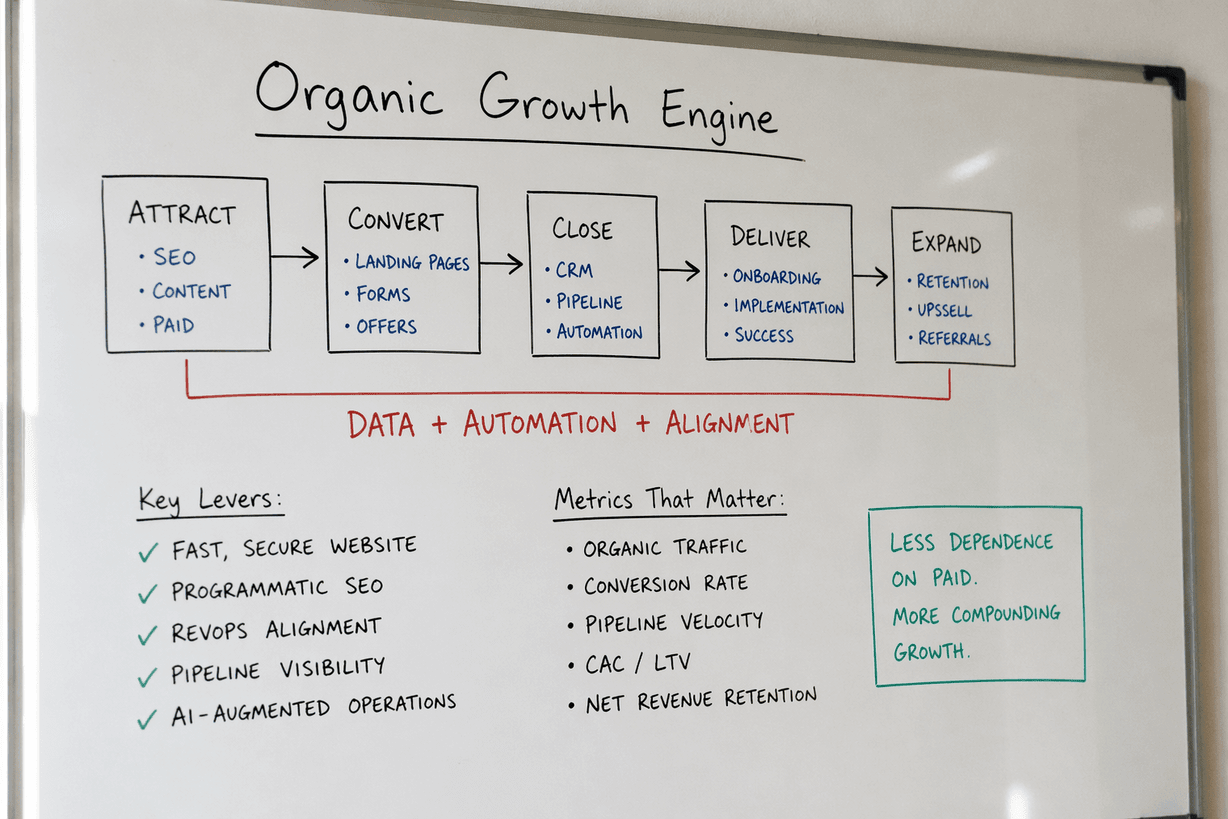
What we build at DevriX is a unified revenue operations layer that spans the full customer lifecycle:
Unified data model. One customer record across HubSpot/Salesforce, marketing automation, support platforms, and billing. No more "which system is the source of truth?" debates. The answer is: one system, one record, reconciled nightly.
Lifecycle stage mapping with SLAs. Every transition from anonymous visitor to MQL to SQL to closed-won to onboarded to renewed has a defined owner, a time-bound SLA, and an alert when it breaks. We've reduced lead-to-close cycles by 25-35% with this alone.
Attribution & pipeline intelligence. Multi-touch attribution that connects the blog post someone read 90 days ago to the $200K deal that just closed. This isn't vanity reporting. It tells you where to invest the next dollar.
Automated workflows replacing manual handoffs. When a deal closes, the CS team gets a structured brief with deal context, implementation notes, and the customer's success criteria, automatically. No more "can you forward me the proposal?" emails three weeks into onboarding.
The companies that get this right don't just grow faster. They grow more predictably, which is the entire point when you're managing to a 3-5 year hold period and need to show trajectory to the next buyer.
3. The tech stack treated as a cost center vs. a value creation engine
Most portfolio companies accumulate tools the way a garage accumulates boxes. Somebody needed something, they bought it, and now there are 14 SaaS subscriptions doing overlapping things while critical workflows still run through email and spreadsheets.
We audit tech stacks regularly. The typical mid-market company spends $15K to $40K/month on SaaS tools and uses maybe 30% of the capability they're paying for. Worse, the tools don't talk to each other, so data lives in silos and nobody trusts the dashboards.
Our approach:
Consolidate ruthlessly. We've cut tech stack costs by 40-60% for some portfolio companies by eliminating redundancy and replacing 4 tools with one properly configured platform. HubSpot alone, when set up correctly, replaces most of the marketing automation + CRM + ticketing stack that companies are paying three separate vendors for.
Build integrations that create data flow. WordPress feeding HubSpot feeding BigQuery feeding Looker. The point isn't the tools. It's the pipeline: lead comes in, gets scored, gets routed, gets worked, gets closed, gets onboarded, gets tracked for expansion. Every step automated, every step measured.
AI-augmented operations. We deploy AI agents for content generation, lead enrichment, competitive monitoring, and reporting automation. Not as experiments. As production systems that reduce the need for 2-3 FTEs per portfolio company while improving output quality. This is where our agentic infrastructure work (n8n, Claude API, Temporal, Supabase) plugs directly into client operations.
4. Organic growth compounds. Paid growth doesn't.
This is the fundamental argument for investing in the organic engine early in the hold period.
Paid media is a lever you can pull quickly, and we're not against it (several of our long-term partners pump $5M to $50M in paid social or paid search annually).
But every dollar you spend on paid is a dollar you need to spend again next month. Organic growth (SEO, content, community, referral, product-led) compounds. The blog post you publish today generates traffic for 3 years. The programmatic SEO infrastructure you build generates leads while you sleep.
The math is straightforward:

Paid CAC for mid-market B2B: $800 to $2,500 per qualified lead, trending up every year as auction-based platforms get more competitive.
Organic CAC after 12-month ramp: $150 to $400 per qualified lead, trending down as the content library and domain authority grow.
Blended impact on EBITDA: A portfolio company that shifts from 90/10 paid/organic to 50/50 over a 24-month period typically sees a 15-20% improvement in marketing efficiency, which drops directly to EBITDA.
Organic takes 6-12 months to build momentum. Which is exactly why you need to start in the first 100 days post-close, not in year two when the paid budget is already strained and the operating partner is asking why CAC keeps climbing.
The DevriX model bridging the gap for 15 years
We're not a "WordPress agency" and we're not a "RevOps consultancy." We're the execution arm that PE operating partners and mid-market leadership teams bring in to build the organic growth infrastructure that compounds through the hold period.
Our standard retainers ($10K to $60K/month) typically tap into the right stage for mid-market companies or dive head-first in different M&A stages, including:
Enterprise WordPress development & platform management. Architecture, performance, security, compliance, and ongoing iteration. Not a project with a start and end date. A managed platform that evolves with the business.
RevOps implementation & optimization. HubSpot/Salesforce configuration, lifecycle mapping, pipeline automation, attribution modeling, and cross-functional alignment. We embed with your sales, marketing, and CS teams.
Programmatic SEO & content infrastructure. Scalable content systems that generate organic traffic and inbound pipeline. AI-augmented content production with senior editorial oversight.
Data engineering & business intelligence. BigQuery, Airflow, Looker, and custom dashboards that give operating partners real-time visibility into portfolio company performance.
AI operations deployment. Production-grade agentic systems for lead enrichment, content workflows, competitive intelligence, and reporting automation.
And a handful of specialized solutions for FP&A, PMI management, value creation GTM plans, experimentation as a service, and other levers we find that move the needle.
We've been doing this for 15+ years with companies ranging from $10M to Fortune 500, across healthcare, professional services, SaaS, e-commerce, finance media/publishing, and specialized distribution. We're not learning on your portfolio company's dime. We've seen the patterns, built the playbooks, and know where the leverage points are.
This week's action plan
Pick one portfolio company and run this diagnostic:
Day 1: Website audit. Pull up Google PageSpeed Insights and run the homepage. Check the load time, CWV scores, and mobile usability. Then search for the company's core service keywords on Google. Where do they rank? Page 1? Page 5? Nowhere? Document the gap between where they are and where they should be.
Day 2: Pipeline source analysis. Pull the last 90 days of closed-won deals and tag each one by source: paid, organic, referral, outbound, event, partner. Calculate the percentage split. If organic is under 20% of pipeline, you have a structural problem.
Day 3: Tech stack inventory. List every SaaS tool the company pays for. Note which ones integrate with each other and which ones don't. Identify the 3 biggest data silos. Calculate total monthly spend and estimate utilization percentage.
Day 4: Handoff mapping. Interview one person each from marketing, sales, and CS. Ask: "What happens when you hand off to the next team?" Document every gap, delay, and workaround. Count the manual steps.
Day 5: Build the case. Take your findings and calculate the estimated annual cost of the gaps: lost leads, slow cycles, wasted spend, preventable churn. Present a 90-day remediation roadmap to the operating partner with one owner and three measurable outcomes.
Mario
My take
💸 Organic CAC trends down. Paid CAC trends up. After a 12-month ramp, organic B2B leads cost $150 to $400. Paid sits at $800 to $2,500 and climbs every year as auction-based platforms get more competitive. Companies that shift from 90/10 paid-to-organic to 50/50 over 24 months typically see a 15-20% improvement in marketing efficiency - which drops directly to EBITDA.
🧪 Operational execution is the new value creation thesis. The era of cheap debt and multiple expansion is behind us. What remains is the harder work: building the systems, data infrastructure, and organic GTM motion that make a portfolio company genuinely worth more to the next buyer - not just positioned to look that way during diligence.
Market insights & opportunities
Oscar Health launches Lucie to make U.S. healthcare “shoppable”. Oscar Health debuted Lucie Health Marketplace, an AI-powered, all-in-one storefront where consumers and brokers can compare and buy individual medical, dental, vision, and ancillary plans, and CEO Mark Bertolini says it aims to make healthcare shopping as easy as booking a hotel.
Felicis leads $70M round for next-gen autonomous threat detection. The round attracted participation from First Round Capital, Brightmind, Theory VC, Two Sigma, and cybersecurity veterans from Microsoft, Okta, CrowdStrike, and more, underscoring demand for next-gen security against AI-driven threats.
The quantum bottleneck isn’t chips, it’s lasers. Vexlum argues quantum, atomic clocks, and semiconductor metrology are limited by the scarcity of compact, affordable, high-power lasers at precise wavelengths, and is scaling VECSEL production to address it.
Italy’s VC ecosystem posts $1.7B in 2025 and strong Q1’26 follow-through. The enterprise value of Italian tech companies has more than doubled since 2022, now employing nearly 130,000 people and housing 17 unicorns, illustrating expanding scale and investor confidence.
🌐 Your website is a dormant sales asset. Most PE-backed companies spend heavily on paid channels while their site loads in 9 seconds, ranks for nothing, and converts at under 1%. Sub-2-second load times and programmatic SEO infrastructure are the kinds of improvements that drive 30-40% organic traffic growth within a quarter - without a single additional dollar in paid spend.
🩸 Revenue gaps in PE portfolios compound quietly. Disconnected CRM data, undefined handoff SLAs between marketing and sales, and organic channel neglect rarely show up in board decks until the pipeline has already softened. The structural causes of mid-market revenue loss are almost always surfaced in a 90-day GTM audit - long before they show up as a value creation problem.
📉 Paid-dependent growth was fragile before acquisition. The close just makes it visible. Pull the budget back 15% and revenue stalls overnight - because the growth model was never self-sustaining. Mid-market companies that falter post-acquisition typically share one trait: no organic foundation was built while capital was available to build it.
🔗 RevOps alignment across portcos requires a shared language. Each portfolio company carries its own CRM logic, pipeline definitions, and reporting gaps. Standardizing revenue operations across portcos starts with one data model and one lifecycle framework.

Course Review Affiliate Website: 2.5-year-old education-focused content site monetized through affiliate income. Generates passive revenue with algorithm-resistant traffic sources and high margins. Producing ~$1.4K monthly profit, it’s available at $42,000.
Forms & Surveys SaaS Platform: 7-year-old SaaS platform enabling businesses to create forms, surveys, and polls with 30+ integrations. Strong profitability and stable subscriber base. Generating ~$4K monthly profit, it’s priced at $230,000.
KYC & Identity Verification SaaS: 9-year-old blockchain-based SaaS platform automating KYC/AML compliance for businesses. Positioned for enterprise use cases with scalable onboarding infrastructure. Generating ~$10K monthly profit, it’s available for $500,001.
Microlearning Education Platform: 13-year-old eLearning business with a large video library focused on microlearning and distributed via multiple partners. Strong margins and consistent revenue base. Generating ~$600K+ annually, it’s priced at $2,500,000.
Working with me
🌐 Scaling $30M - $100M+ mid-market companies with value creation through RevOps, data engineering, and WordPress. DevriX provides full RevOps consulting + delivery with GTM enablement for PE-backed portfolio companies, traditional tech, healthcare, finance, and professional service businesses pacing toward revenue growth initiatives. Our standard retainers between $10K and $60K include revenue lifecycle services for marketing and sales leaders, FP&A for financial teams, pipeline enrichment through websites and dozens of lead sources, automations and delivery integrations, CRO and ongoing testing, product delivery and platform integration solutions, and more through our consulting solutions.
🚀 1:1 Advisory retainers. At Growth Shuttle, I run two popular plans: Async Advisory ($3,500/mo) for $3M - $30M founders and executive teams and the smaller Strategic Growth Circle ($997/mo) for $100K - $500K entrepreneurs, agency founders, scale ups. My fractional executive plan is also available here.
📈 Building US LLCs from Europe. I help European and Asian founders scale faster through doola and their “Business in a Box” model. Also suitable for US citizens (given their bookkeeping solution), but in very high demand across Europe.
📊 Post-Merger Integration. We take on M&A initiatives with Flippa. Working closely on PMI retainers for PE companies and fast-growing startups integrating new companies within their portfolios, enabling data pipelines, and securing more deals through my personal network.