- Growth Shuttle Insider
- Posts
- 2026 - the year of value, agents and organizational reckoning in PE
2026 - the year of value, agents and organizational reckoning in PE
A human-led, AI-backed analysis + restructuring the newsletter in 2026

Mario Peshev
January 01, 2026

Happy New Year to all investors, PE partners, operators, executives, M&A advisors, industry professionals, and even students following the newsletter (among the 31,000 subscribers). Here’s to a healthy and prosperous 2026 ahead!
2023 was dubbed “The Year of Efficiency” after Zuckerberg took a hit on his Metaverse project, generating an operating loss of $13.7 billion in FY 2022, rising to $16.1 billion in 2023.
What followed reshaped boardroom priorities across tech, private equity, and the mid-market.
Efficiency was not a buzzword, unlike other hypes over the previous years. It was a forced correction, backed by the leading FAANG leaders, investor support, and the public - thanks to the stock market drop of 2022.
Headcount rationalization, portfolio pruning, vendor consolidation, and margin discipline became non-negotiable. Capital was no longer cheap. Growth narratives were replaced by operating models.
That reset set the stage for what followed.
2024: From cost control to building capabilities
If 2023 was about stopping the bleeding, 2024 was about rebuilding muscle.
For PE-backed and mid-market firms, 2024 marked the transition from austerity to selective reinvestment. The focus shifted toward:
Rebuilding operating cadence after layoffs
Institutionalizing metrics beyond revenue growth
Deploying AI and automation inside finance, ops, and GTM
Professionalizing leadership layers ahead of exits or add-ons
This was the year when AI moved from experimentation to adoption. Not moonshots. Not innovation labs. Practical deployment inside pricing, forecasting, customer support, and content engines.
The best operators treated 2024 as a capability year. The rest treated it as a tooling year. That distinction matters going into 2026.
But let’s get through 2025 before the current predictions.
2025: AI across internal teams
By 2025, the new era of AI had advanced sufficiently:
ChatGPT turned two by end of 2024, and OpenAI was receiving billions and billions in additional support
Google’s Gemini was getting integrated across the full suite
Salesforce deployed AI everywhere - with Agentforce being the new big thing
Anthropic made Claude the foundational model for engineering - and other niche industries
Gamma became the go-to presentation layer.
ElevenLabs made voice adoption commodity.
And the biggest one of all:
VIBE CODING got mass adoption across product teams, designers, marketers, and different executive functions (including account managers and CX leaders).
Boards stopped asking “Are we using AI?” and started asking “Where is it changing EBITDA?”
This is where productivity optimization accelerated while AI was thoroughly investigated under the hood.
AI budgets came under scrutiny
Pilots were killed if they did not touch margins
Middle management roles were redefined or removed
Smaller teams were expected to outperform larger 2022 orgs
For PE, this became a diligence issue. AI and automation maturity quietly entered value creation plans, not as upside narratives, but as downside protection.
Mid-market CEOs felt the squeeze most. Same expectations. Fewer resources. Shorter timelines.
➡️ 70% of my own time was spent on PE execution across several of these areas - with contracts upsized and several new deals for incredible businesses. The heat was on - and the turbulence wasn’t always pleasant, but the purpose was clear.
2026 forecast: the year of value capture and 10x operators
I asked AI to assess the previous years of efficiency, the Great Resignation, the Quet Quitting, and other trends over the 2020s.
That’s where it came up with the 2026 one:
🏆️ “Year of Value, Agents and Organizational Reckoning”
Looking ahead, 2026 will bridge the pieces together: with more confidence in automation and LLM support, with redefined roles, T-shaped experts, and my favorite role: The AI Operator (which I believe is the next Customer Support or mid-level manager role handling agents).
For private equity and mid-market operators, three shifts are becoming unavoidable.
1. From tools to systems
2026 is the year when disconnected tools become a liability. We saw enough of that with disjointed SaaS apps and a hundred different licenses in 2021-2022 not speaking to one another.
Firms will be judged on how well existing systems talk to each other:
Forecasting tied directly to sales pipelines
Pricing linked to real-time demand signals
Marketing integrated with revenue accountability
AI agents embedded across workflows, not bolted on
PE operating partners will increasingly push for standardized operating systems across portfolios. Not platforms. Systems.
We spend a good chunk of time on that with our RevOps plans at DevriX, through a proprietary data source analyzing public and private mid-market companies, and their revops maturity.
2. The rise of the “operator-grade” organization
Lean teams are here to stay, but resilience and tough skin are paramount today. All of the corporate “lean back” attitude of the 2010s is getting evaporated fast.
Winning companies in 2026 will be built around:
Fewer layers, higher judgment density
Clear ownership of outcomes, not functions
AI as a first-class team member, not a productivity hack
Managers who understand systems, not just people
This favors seasoned operators over visionary generalists. Execution fluency becomes a differentiator at both CEO and functional leader levels.
3. Valuations will follow proof, not hype
We live in an AI bubble today. And bubbles are not all bad - they fail when valuations don’t pan out and usability is fabricated.
In 2026, buyers and investors will increasingly reward:
Predictable cash flow under volatility
Demonstrated operating leverage post-AI
Evidence of scalable decision-making
Clean data, clean reporting, clean narratives
The systems and models that facilitate that at scale - and contribute at scale toward GMV and revenue growth - will maintain strong valuations and turn into the new FAANG in the coming 2 to 3 years.
What does this mean for the mid-market world?
The Growth Shuttle thesis entering 2026 is simple:
Growth is no longer about headcount and product MOAT is non-existent today.
PE-backed and mid-market leaders who win will incorporate the right mechanisms to drive efficiency, growth, consistency, and data-driven decision-making.
Taking a couple of extra days before Q1 officially starts, with three new contracts kicking off on January 5th.
If your revenue lifecycle plan for 2026 isn’t ready yet, the time is now.
Mario
My Take
👨🏭 LinkedIn delivering a month-old content - I consistently get served content in my feed that’s weeks old - if you’re seeing the same, drop in and let’s investigate.
💼 Hiring in Sofia - our DevriX team is scaling in our HQ in Sofia. If you’re based in Sofia or have peers you can recommend, please touch base here.
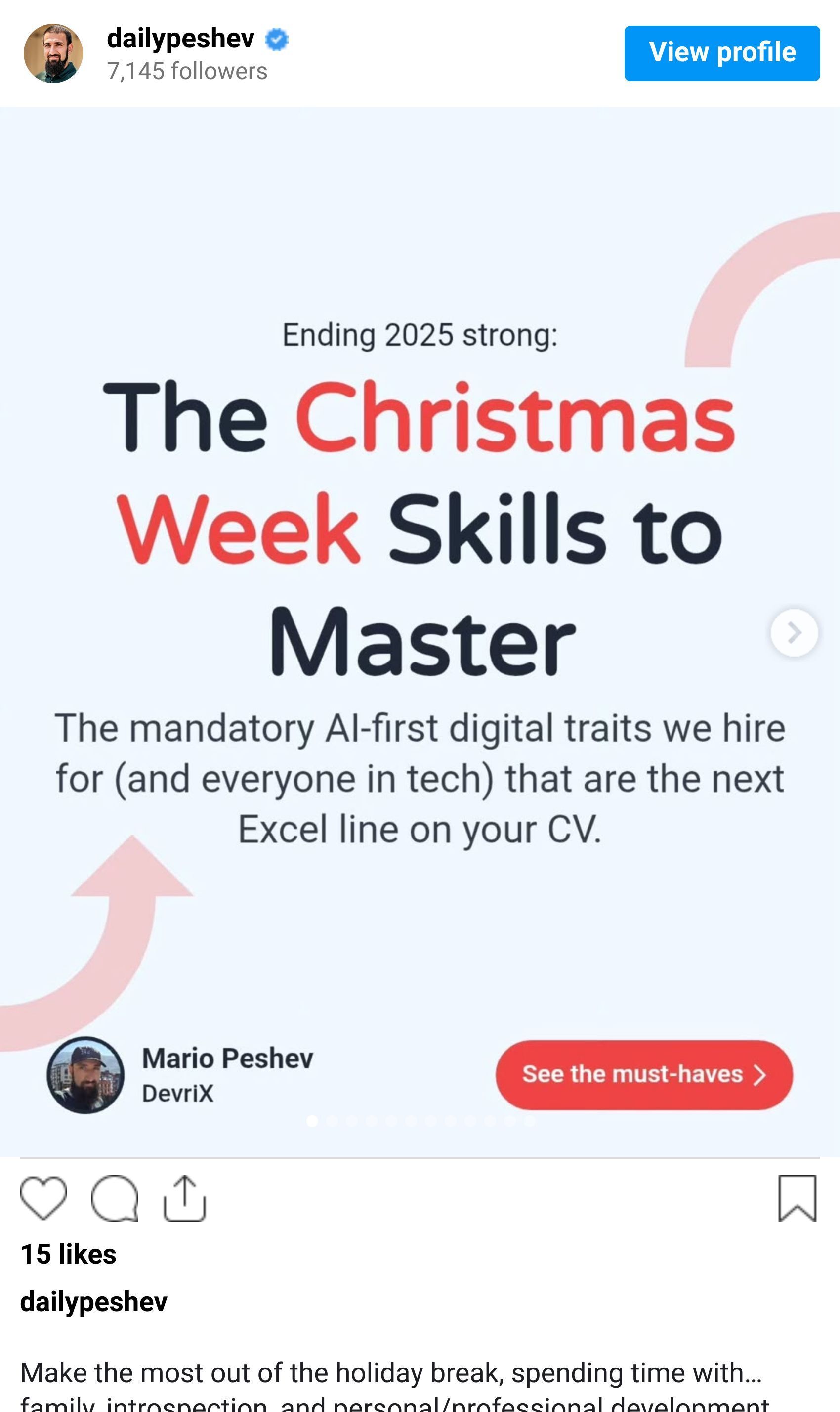
A deck with core skills I recommend studying up on in 2026 ^
Vote for newsletter format of 2026 (1 min)
I’m keeping this edition simplified (no external articles and M&A offers) - what do you want to see as format in the new year?
Should the newlsetter format stay the same in 2026?The 2025 newsletter format followed this structure: - My intro - My take (other posts on social/podcasts/interviews) - Recommended books - Our B2B ecosystem (other sites) - Industry news - Investment opportunities (Flippa) Should we trim, keep, or redo? |
A single click to vote for the format for the new year 👆️
For reference, the newsletter has been going through stages:
AI and RevOps (a 2025 example)
Slashing half the newsletter (the end of 2024 update)
Stock market crash (2024 including stock news)
Down rounds and exits (a simplified ‘24 formatting streamlined)
#AskPeshev text-only (2023)
And earlier versions in the past 5 years.
I’ll be revamping the “Working with me” section as well based on the votes below.
Remember - when product MOAT is irrelevant, data and relationships mean everything. I’ve sent 400+ New Year's Day DMs to industry peers over the past 24 years alone. How about you?
Mario